I don’t need to tell you that rain is poetry (the earth is an open mouth)
By Pascalle Burton
Published 22 April 2026
'X marks the spot—the whole thing’s an X.'
from The Ignoramus of Love by Destroyer
this morning, I stepped outside
it had rained overnight
the darkened bitumen, glistening blades of grass and gutterstream
the untouched ground beneath the cantilevers
an impermanent literary artefact
this is nature’s improvisation
droplets placed in space and time
—just riffing—
large fall fast
small fall slow
no leader, all collective, never boring
and just when you pick the rhythm, the pattern shifts
it shapes us
permeates what it touches
erodes, glides over, refills us
everything atmospheric, everywhere, always
playing its part in the rise and fall of civilisations
can tears form raindrops and cross the globe?
be flushed into rivers and oceans 14,000 kilometres away
sucked into turbulent air currents
landing its song on strange surfaces
kissing the sand on a beach
or a hill outside a city
then, in its own time, swept back up and carried to meet you
what do we water when we cry?
or maybe what I mean is
what do we help to live?
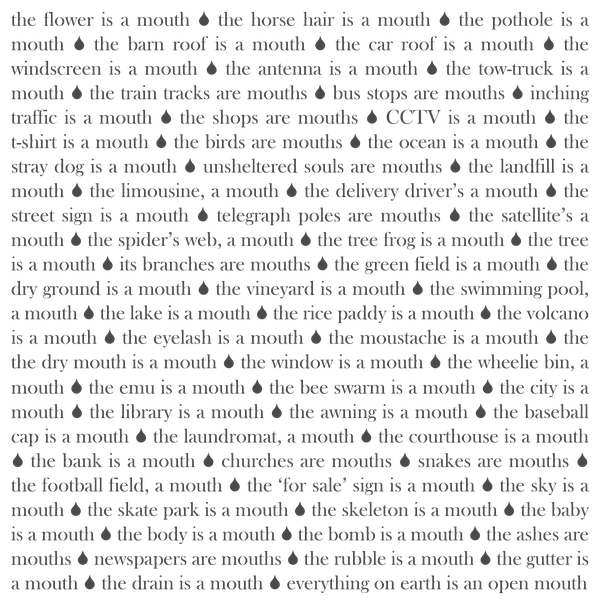
The second part of this poem is intended to be read lightly and rhythmically underneath the first part.
"everything atmospheric, everywhere, always" is from a 1960 report by John Bellamy and Harry Wexler written about the measuring capacity of TIROS-1, the first operational weather satellite.
"never boring" refers to the 1969 poem Rain by Francis Ponge (translated by Joshua Corey and Jean-Luc Garneau), where rain is described as ‘a concert without monotony’.
Poets are often asked the question, ‘What is poetry?’ My answers to this tend to be multiple and open because poetry can inhabit so many dimensions. The prompt for this year’s Poem Forest – The Sounds of Country – immediately brought me to the same feeling about rain. Rain is a great connector to absolutely everything. It is tangible, audible and transformative. It can nourish and demolish. I wanted to capture the artistry of rain: from the temporary marks it creates to the rhythmic sounds it makes, like an uninhibited painter or musician.
I also started to think about the rain cycle’s ability to move particles from one place to another. With a genocide being live-streamed across the globe and, simultaneously, urgent humanitarian aid being blocked from getting into Gaza, I wanted to imagine how rain could have the ability to transcend those enormous distances and systemic barriers.
I recorded the rain from inside my car and eventually used this in the audio. But I also wanted to capture rain’s sonic element in the poem itself and so the second visual poem began to materialise. I could imagine it being read lightly underneath the first part to give the effect of ambient rain.
In terms of form, I’ve used pattern but also tried to lean into natural shifts. In the main poem, the lines in each stanza are of variable lengths with five lines in the first and third stanzas, seven in the second and fourth and three in the closing stanza. In the second visual poem, I hope to have captured this sense of pattern and shift, too; the recurring metaphor of the mouth is ‘breathing’ rhythmically but the shifts come through the visible length of the words and the subsequent spacing of the raindrops.
The poem was made, including recording the rain, in Magan-djin on unceded Yuggera, Jagera and Turrbal lands, and I pay my respects and gratitude to the Traditional Owners and Custodians, and to Elders past and present.