
Learning Resource 2026: The Sounds of Country
Using this Learning Resource
This curriculum-linked Learning Resource is designed to support students and teachers to find inspiration before composing their poems.
It features a range of multi-modal Pre-Writing Prompts and Nature Case Studies to enrich curriculum outcomes across English, Science, Sustainability, First Nations Histories and Cultures, The Arts, Humanities, Social Sciences and Technology.
As Poem Forest is open to students from Foundation to Year 12, activities can be adapted to suit the needs of different age groups. The order of lessons is flexible, although we recommend delivery over two to three sessions to allow students to reflect, conceptualise and respond. Lessons & activities are designed to help students engage through sensory experiences, poetic examples, creative thinking and research skills to support their own creative process.
Commissioned Poems exemplify a range of poetic techniques and give students insight into different voices, styles and perspectives.
Pedagogy
The Poem Forest Pedagogical Framework reimagines education as poetic reciprocity with Country. Students are not merely observers of nature, but participants within its living systems. To write with Country is to remember that we are part of her story. Country becomes poetry; every poem becomes a seed.
In many First Nations knowledge systems, listening is knowing. The Sounds of Country positions dadirri (deep listening) as the foundation of poetic, ecological, and cultural education. Students become listeners first, writers second.
Poem Forest is a proudly First Nations-led program. We know some educators can be cautious to teach First Nations content for fear of “doing it wrong”. This is why we have developed this Learning Resource in alignment with 8 Aboriginal Ways of Learning so that you and your students can confidently and creatively engage with The Sounds of Country in a way that works for you.
Here are 5 important elements of our pedagogy:
Dadirri: ("da-DID-ee")
verb: deep listening, contemplation
From the Ngan'gikurunggurr and Ngen'giwumirri languages of the Daly River region.
It involves quiet, patient attention without rushing or interrupting, allowing understanding to emerge naturally.
- Dadirri is about being fully present and connected — to stories, places, people, and the natural world.
- It fosters a calm, reflective awareness that guides thoughtful action and respectful communication.
- More than just an Aboriginal practice, Dadirri is a universal capacity for deep listening and inner knowing.
Dadirri is a vital element of the Poem Forest Pedagogical Framework because it grounds education in deep, attentive listening that connects students intimately with Country. By prioritising Dadirri, students move beyond passive observation to become active participants who cultivate calm, respectful awareness — essential for engaging poetically, ecologically, and culturally with the living stories of the land.
“Dadirri is in everyone. It is not just an Aboriginal thing.” (Dr Miriam-Rose Ungunmerr-Baumann AM, Aboriginal Elder, Educator, Artist and Senior Australian of the Year 2021 )
When we speak of “Country”, we mean more than just land, water, and sky. Country includes:
- All living beings in a place — bugs, birds, and bushes
- The knowledge held by a place — its stories, history, and medicine
- Cultural practices — song, dance, and ceremony
- Responsibilities connected to a place — such as river people caring for rivers
The Sounds of Country invites you to listen closely to the many voices of Country. By paying attention, Country teaches us how to care for plants, animals, and places with respect. Listening with both our ears and hearts helps us give Country a voice through our words.
Through everyday songs and rhythms, The Sounds of Country encourages curiosity, imagination, and a deep love for the land you are on. It is about learning to listen and create with Country.
When we listen deeply — with our whole bodies, hearts, and spirits — we begin to hear Country speaking. In this way, poetry is not simply written; it is heard into being.
As a pedagogical practice, deeply listening to Country is important because it:
- Cultivates respectful relationships between students and the natural world, fostering empathy and care.
- Encourages holistic learning that integrates ecological, cultural, and emotional knowledge beyond traditional classroom boundaries.
- Empowers students to become active participants in their environment, recognising their role within living systems rather than as detached observers.
- Supports cultural understanding and reconciliation by honouring First Nations ways of knowing and connecting learners to Indigenous perspectives.
- Nurtures creativity and imagination through poetic engagement, helping students express and share their connection with Country authentically.
This approach creates a grounded, meaningful learning experience that inspires stewardship and belonging.
“Aboriginal perspectives are not found in Aboriginal content, but Aboriginal processes...”
The Poem Forest Way of teaching and learning is rooted in First Nations perspectives that emphasise process over content, inviting educators and students into a relational, experiential engagement with knowledge. Unlike conventional Western education, which often treats knowledge as fixed, neutral information delivered by experts, the Poem Forest Way understands learning as a dynamic interplay between people, place, culture, and time. Meaning emerges through relationships: between the poem and the reader, the learner and their community, and importantly, between humans and Country. This approach honours that all things exist through connection and context, making learning a deeply personal and communal journey.
Central to the Poem Forest Way are three guiding principles: relationality, storywork, and Country-as-teacher. Stories are not just texts to analyse but living teachers carrying knowledge, ethics, and responsibility that engage heart, mind, body, and spirit. Learning comes from listening attentively to place, the land, water, seasons, and more-than-human life, recognising that knowledge is something lived through care and responsibility, not merely memorised.
Educators facilitate this by creating space for Country to teach, encouraging students to respond poetically and thoughtfully to their surroundings. This way of learning invites reflection, curiosity, and respect, fostering a deep connection with the world that nurtures both cultural understanding and environmental stewardship.
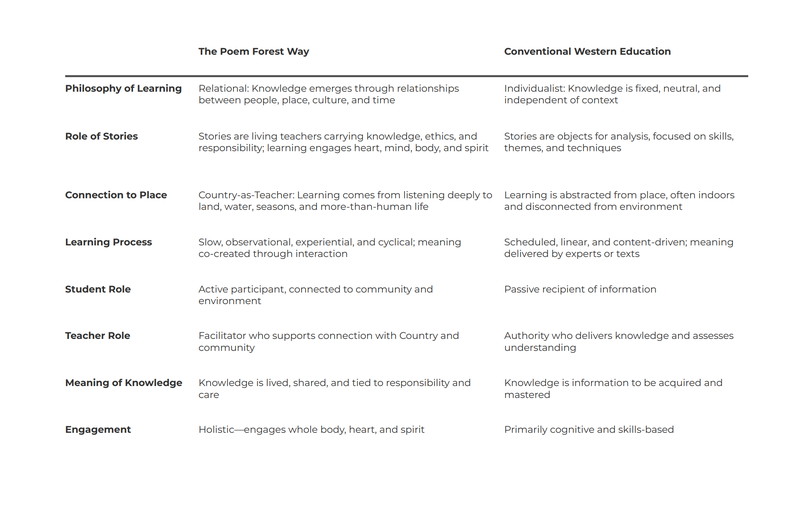
This comparison highlights how the Poem Forest Way fosters a deeply connected, respectful, and embodied approach to learning, contrasting with the more detached and transactional nature of conventional Western education.
The Poem Forest way aligns with the The 8 Aboriginal Ways of Learning. 8 Ways is a pedagogy framework expressed as eight interconnected pedagogies, and it is perfectly suited for deep engagement with Sounds of Country.
- Story Sharing: Approach learning through narrative. We connect through the stories we share.
- Learning Maps: Explicitly map/visualise processes. We picture our pathways of knowledge.
- Non-verbal: Apply intra-personal and kinaesthetic skills to thinking and learning. We see, think, act, make and share without words.
- Symbols and Images: Use images and metaphors to understand concepts and content. We keep and share knowledge with art and objects.
- Land Links: Link content to local land and place. We work with lessons from land and nature.
- Non-linear: Produce innovations and understanding by thinking laterally or combining systems. We put different ideas together and create new knowledge.
- Deconstruct/Reconstruct: Model and scaffold, working from wholes to parts (watch then do). We work from wholes to parts, watching and then doing.
- Community Links: Centre local viewpoints, apply learning for community benefit. We bring new knowledge home to help our community, our mob.
Put simply, there are 8 ways to start the learning process:
- Tell a story
- Make a visual plan
- Think and do
- Draw it
- Take it outside
- Try a new way
- Watch first, then do
- Share it with others
How will you share the 8 Ways with your students? Remember to prioritise the Relational, Storywork and Country-as-Teacher.
SEE IT IN ACTION
Take your students outside.
Could they draw the 8 ways in sand, or replicate the diagram using bark, stones, school bags?
Together, can you identify 8 landmarks in your area and assign them a Way?
Why not make up a hand-clap (you’ve got 8 fingers!) or a dance?
Can you make up a story with 8 characters based on the 8 Ways?
Where do your students see 8s in the world (flower petals, notes in a scale) and how could these become part of Sounds of Country learning?
Why not create 8 small groups who are responsible for ensuring their Way gets a fair go during Sounds of Country time?
Try something different. Share your learning with us!
The Sounds of Country is not just about doing a bunch of learning activities — it’s about reimagining the very ways we approach our learning. We think relationally, we think in story, and we think Country-as-teacher.
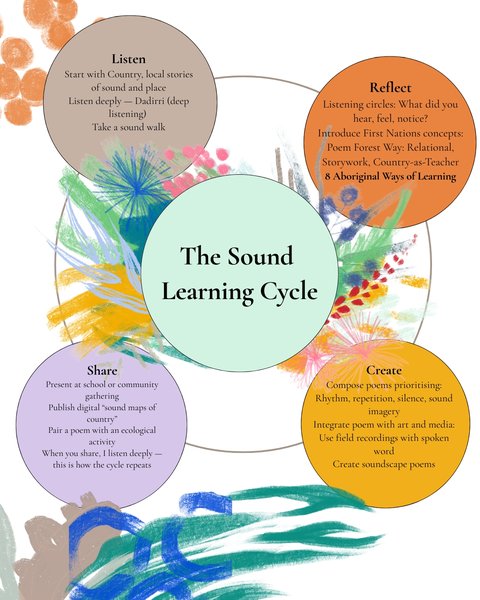
We also think in circles and cycles (Cycle Thinking) rather than straight lines. That’s where our Sound Learning Cycle is helpful:
We listen, we reflect, we create, then we share.
Just like the seasons, The Sounds of Country is designed so you and your students can keep returning to learning. Everybody knows that this summer will have similarities to last summer, whilst also being new and different. In the same way, you and your students will benefit from returning to The Sounds of Country activities, places and ideas again and again.
When you share, I listen. This is how the Sound Learning Cycle repeats.