
Discover the power of language to carry Country’s voice and spirit
This lesson invites students to listen deeply to the true sound of Country through language and poetry, nurturing respect, connection, and creativity.
Listen
Indigenous languages hold the true sound of Country. They come from listening closely to the sound of Country - the call of a Kookaburra, the flow of water...
They carry stories, knowledge, and connection across generations. Poetry in language is a powerful living expression of culture and place.
Listen to poems by these incredible First Nations poets, who use their languages to share Country’s voice and spirit:
Ado (Adrian) Webster
Melanie Mununggurr
Jacob Morris
Lorna Munro
Kara Tuck
Aunty Theresa Sainty
Notice the sounds, rhythms, and emotions in the poems, even if you don’t understand every word. Can you hear Country in the sounds of the words? The onomatopoeia?
Pay attention to how the poets blend language, voice, and Country.
Reflect
Think about the role of language in connecting people to Country:
- How does hearing poetry in Indigenous languages feel different from poetry in English?
- What emotions or images do the sounds and rhythms evoke?
- How might language carry knowledge, stories, and responsibilities connected to Country?
- Why is it important to listen to and respect these languages?
Create
Explore language and sound in your own poetry:
- Write a poem inspired by Country, place, or story.
- Experiment with sound and rhythm: use repetition, melody, or invented words to evoke feeling and connection.
- Try including words or phrases from your own language, family language, or an Indigenous language you have permission to use.
- Focus on how the poem sounds when spoken aloud — let the voice carry the spirit of the words.
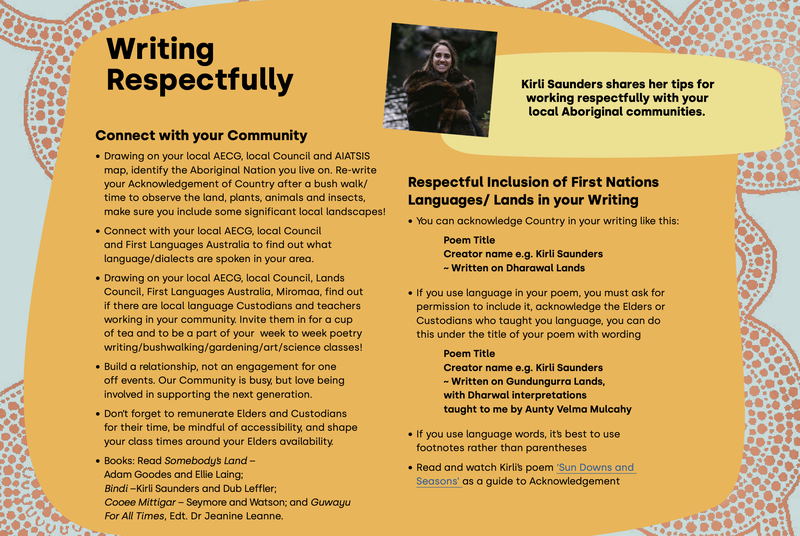
Remember that to write respectfully, it's important to connect with your local Aboriginal community, ask for permission, and acknowledge Language words and cultural concepts and who taught them to you. You can read more about this in Kirli Saunders' guide to writing respectfully.
Share
- Share your poem aloud with family, friends, or classmates.
- Listen respectfully to poems in different languages or with different sounds.
- Reflect on the power of language to connect us to Country and each other.
- Use Cycle Thinking: Share, listen, reflect — then create again!

Tips for Teachers and Families
- Encourage students to explore language as sound and connection, not just meaning.
- Support respectful learning and use of Indigenous languages with permission and cultural guidance.
- Highlight the importance of oral tradition and spoken word in Indigenous cultures.
- Foster a safe space for sharing poems in different languages and sounds.
- Connect this activity to local Indigenous language programs or elders where possible.
- Use Cycle Thinking to deepen understanding and respect for cultural diversity.