

Feel it. Play it. Share it. Make your poem sing!
This lesson invites students to feel the music in their poetry and use sound to bring Country’s voices alive.
Listen
Poetry was made to be heard aloud. Like music, it’s about feeling the rhythm and sounds, not just reading words on a page. Many musicians can’t read music but feel it deeply — and that’s how poetry works too.
Sounds of Country is about listening, reflecting, and creating poems that come alive when spoken. Today, we’ll explore ten powerful sound devices that make poems sing in the air.
Reflect
Before we play with sound devices, you need a poem to work on! You can:
- Write your own poem first inspired by your listening and reflection on Country.
- Or choose a short poem from previous Poem Forest years (see curated examples below).
Once you have a poem, listen to how it sounds when you read it aloud. Notice places where sounds jump out or where the poem feels flat.
Create
Step 1: Write or Choose a Poem
- Write a poem inspired by your experience of Country or choose one from the curated set below.
Step 2: Explore Sound Devices
Play with these sound devices by rewriting your poem to include them. Try one at a time or combine several!
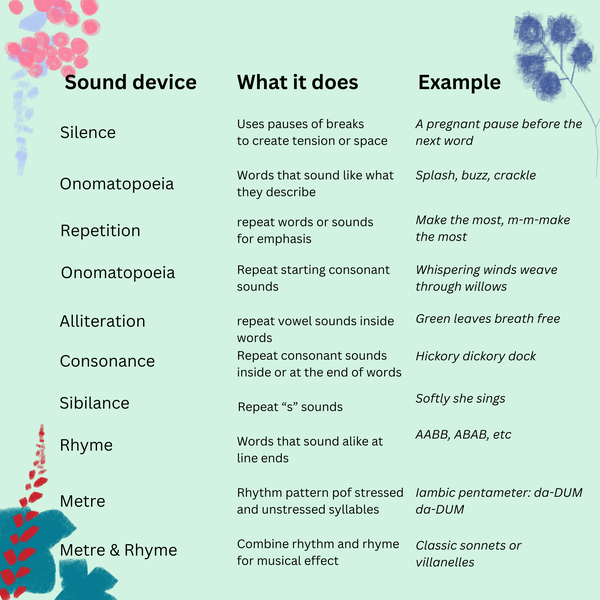
Step 3: Try It Out
- Rewrite lines or stanzas using one or more sound devices.
- Read your poem aloud — how does the sound change the feeling?
- Experiment with rhythm and pauses to create “sound imagery” that brings your poem alive.
Curated Short Poems for Rewriting
Poem 1: Whispering Leaves
The leaves whisper softly,
Dancing in the breeze,
A gentle song of green,
Carried through the trees.
Poem 2: River’s Call
The river calls and flows,
Splashing over stones,
A song of endless journeys,
In murmurs and tones.
Poem 3: Morning Light
Sunlight spills like honey,
Warm on earth and sky,
Birds sing their morning tune,
As clouds drift by.
Poem 4: Quiet Night
Stars blink in silence,
Moon glides on high,
The night hums softly,
A lullaby.
Poem 5: Footsteps
Footsteps fall like raindrops,
Soft upon the ground,
Echoes of a journey,
Without a single sound.
Examples to Get You Started
Original:
The river sings softly,
A lullaby of stones and streams.
With Onomatopoeia & Repetition:
The river sings softly, softly,
Splash, splash, a lullaby of stones and streams.
Original:
Leaves dance in the wind,
A rustling song of green.
With Alliteration & Assonance:
Leaves leap and linger,
Rustling rhythms in the breeze.
Learn More
Explore more poetic devices and examples with Red Room Poetry’s interactive resource:
Poetic Devices – Red Room Poetry
Share
- Share your original and rewritten poems with family, friends, or classmates.
- Notice how sound devices change the mood and flow of your poem.
- Create a Listening Circle or display poems side by side for everyone to hear and see.
- Use Cycle Thinking: Share, listen, reflect — then create again!

Tips for Teachers and Families
- Encourage students to write a first draft before experimenting with sound devices.
- Provide examples and model how sound devices enhance poetry.
- Support students in reading poems aloud to hear the effects of sound devices.
- Celebrate creative risk-taking and multiple rewrites as part of the process.
- Link sound devices to Indigenous oral storytelling practices and the power of spoken word.
- Use Cycle Thinking to encourage ongoing reflection and creative growth.